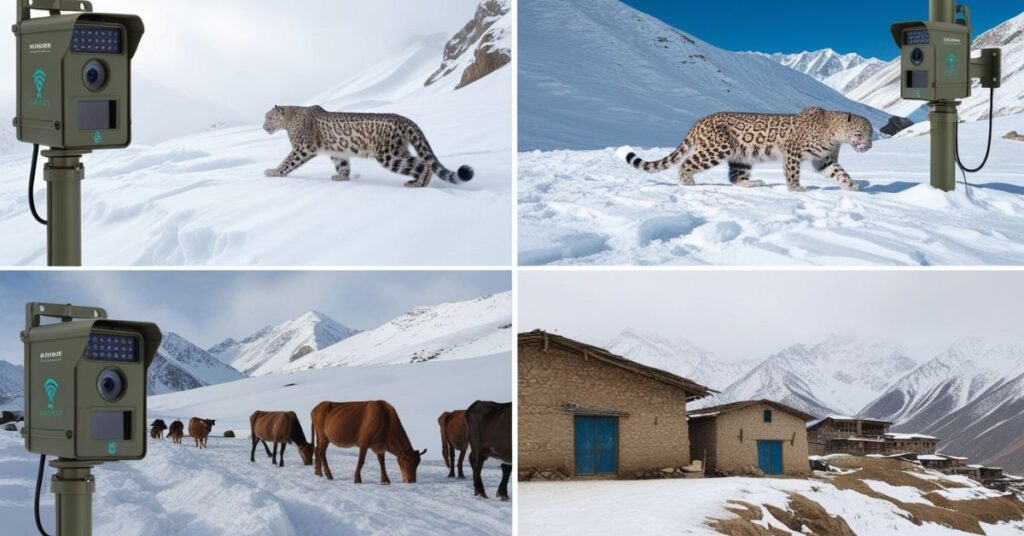
The advancement of artificial intelligence (AI) has paved the way for transforming human-wildlife conflicts into more harmonious coexistence, particularly in regions like Gilgit-Baltistan (GB), Pakistan. This northern region, home to the endangered snow leopard, has long been plagued by conflicts between local communities and wildlife due to livestock depredation by the elusive predator. However, thanks to AI-based technology introduced by the World Wide Fund for Nature (WWF)-Pakistan, a promising shift is now underway.
The Human-Wildlife Conflict in GB
For years, the human-snow leopard conflict has posed a major challenge for conservation efforts in Gilgit-Baltistan. Snow leopards (Panthera uncia), native to the mountain ranges of Central and South Asia, were often retaliated against by local herders for preying on their livestock. Such actions not only threatened the snow leopard population but also exacerbated economic losses for livestock owners.
Aside from retaliatory killings, the snow leopard population has been endangered by poaching, illegal hunting, and habitat loss, which are intensified by climate change. According to WWF, fewer than 7,000 snow leopards remain globally, with about 200 to 420 residing in Pakistan’s northern regions, including Gilgit-Baltistan, Khyber Pakhtunkhwa, and Azad Jammu and Kashmir.
AI: A Game-Changer for Coexistence

In 2022, WWF-Pakistan, in collaboration with the Lahore University of Management Sciences, introduced a solution to this ongoing conflict by installing AI-based trail cameras at critical locations in Gilgit-Baltistan. These cameras are designed to detect the presence of snow leopards and alert nearby communities in real-time. This early warning system enables local herders to take preventive measures, such as safeguarding their livestock, before a potential attack occurs.
The AI system works by collecting data from the cameras and transmitting it to a central hub, where alerts are generated and shared with the community. This not only helps in protecting livestock but also fosters a positive relationship between humans and wildlife. The WWF has reported a significant reduction in livestock losses due to snow leopard attacks at the project sites, indicating a growing balance between humans and the endangered species.
Symbiotic Relationship and Conservation Gains
By reducing human-snow leopard conflicts, AI technology is helping foster a symbiotic relationship between local communities and wildlife. Hammad Naqi Khan, Director General of WWF-Pakistan, emphasized that AI is crucial not only for snow leopard conservation but also for protecting the livelihoods of local herders. This technology is creating a win-win situation, where snow leopards can thrive in their natural habitat, while local communities suffer fewer economic setbacks.
In addition to protecting snow leopards, AI could be applied to other endangered species facing similar threats. For instance, a recent success story involved an AI-based system in India that saved a herd of 60 elephants from a train collision. These advancements suggest that AI holds significant potential for wildlife conservation beyond Pakistan.
Balancing Development and Wildlife Protection

While AI technology is making strides in wildlife conservation, WWF’s April 2024 study stressed the need to strike a balance between infrastructure development and wildlife protection. Linear infrastructure such as roads and railways has fragmented the snow leopard’s habitat, restricting their movement and posing a threat to their survival. Hence, while AI is an effective tool, holistic approaches that include safeguarding habitats are necessary for long-term success.
In conclusion, AI has provided a significant breakthrough in transforming the age-old human-wildlife conflict into a more harmonious coexistence in Gilgit-Baltistan. This innovative solution is helping to conserve endangered snow leopards while also protecting the livelihoods of local communities. Through continued advancements and careful planning, AI could serve as a vital tool for wildlife conservation efforts across the globe.
FAQs:
1. How is AI used in wildlife conservation?
AI is extensively used in wildlife conservation to monitor animal populations, track migratory patterns, and predict threats like poaching or habitat loss. Tools such as AI-enabled cameras and drones help detect illegal activities and safeguard endangered species. For instance, AI systems like TrailGuard detect poachers in protected areas, and machine learning models analyze large-scale data from images and videos to monitor biodiversity and environmental changes. Such innovations enable conservationists to act swiftly and efficiently in preserving wildlife
2. What is the wildlife of Gilgit-Baltistan?
Gilgit-Baltistan is home to diverse and unique wildlife, including iconic species such as the snow leopard, Himalayan ibex, markhor (Pakistan’s national animal), and the Ladakh urial. The region’s high-altitude terrain also supports rare bird species like the golden eagle and Himalayan griffon. Conservation efforts are critical due to threats like habitat destruction and illegal hunting
3. What is the role of AI in environmental conservation?
AI contributes significantly to environmental conservation by analyzing satellite imagery for deforestation trends, predicting climate change impacts, and managing natural disasters like wildfires and floods. It also helps restore ecosystems by tracking species recovery and enabling precision interventions such as reforestation with drones. AI-powered solutions provide valuable insights for sustainable management of natural resources
4. What is AI used for in animals?
AI applications for animals include tracking their movements through GPS-enabled collars, analyzing vocalizations to understand behaviors (e.g., creating “elephant dictionaries”), and monitoring health and population dynamics. AI systems also help in reducing human-wildlife conflicts by predicting animal movements and alerting communities in advance
5. What is the national animal of Gilgit?
The national animal of Pakistan, and by association significant in Gilgit-Baltistan, is the markhor, a type of wild goat known for its impressive spiral horns and its resilience in mountainous habitats
6. Can we talk to animals using AI?
While direct “talking” to animals is not yet possible, AI is enabling better understanding of animal communication. For example, AI models analyze animal sounds, like whale songs or elephant calls, to interpret their meanings. This progress could eventually allow for more advanced interactions or interventions to help protect species